.svg)

Categorized transactions and a Profit & Loss statement. For most businesses, that’s their “accounting.”
Simple. That’s how we all like things to be.
However, as a business grows, revenue isn’t the only thing that stops being simple. Expenses get more complicated. There’s debt. Taxes get more expensive. Cash flow gets harder to manage.
And yet most Profit & Loss statements just get longer. More lines and more pages. And a longer report is the only “upgrade” a lot of owners settle for.
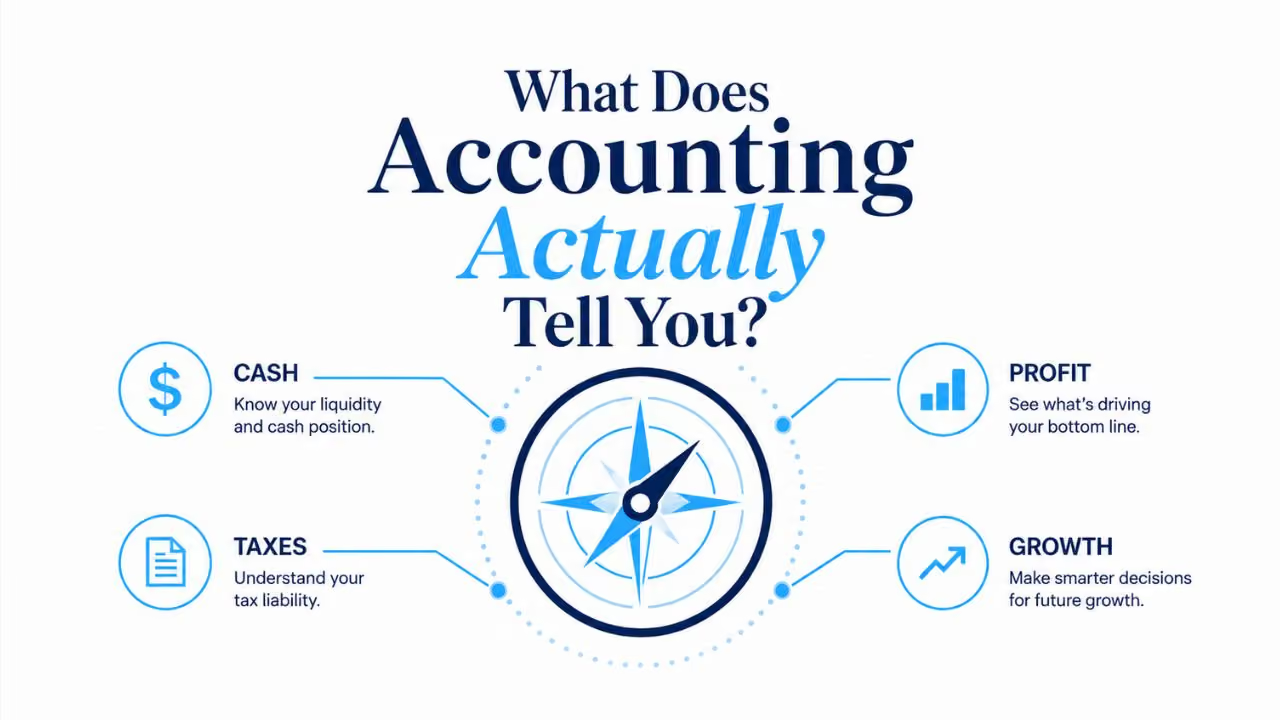
Accounting tells you what the numbers mean and support what to plan for next.
Most service businesses think this upgrade isn't worth it. The books may be accurate. But accurate books don't answer the questions a real business needs answered:
None of that gets answered by a stack of reports.
Before reports can be useful, the underlying bookkeeping has to be right. Not just current and accurate, but reflecting how the business actually operates.
For a growing service business, that means:
The goal is to control the complexity and added costs that growth has already brought into the business.
An affordable service can become expensive when there is no deadline or certainty around delivery.
A professional close means the books are finalized on a consistent timeline after month-end. Banks, credit cards, and CRMs (where applicable) are reconciled. Unusual transactions are reviewed. Missing items are investigated. And meaningful reports are prepared.
Without a reliable month-end close, things just pile up, and growth becomes harder and more expensive to control.
The Profit & Loss statement is still one of the most important statements in a financial report.
But a generic QuickBooks P&L rarely tells the whole story.
A strong month may come from a one-off project, a client prepayment, a delayed expense, a past-due payment finally collected, or an unusual engagement. None of that necessarily means the business is on a stronger financial path.
A useful monthly accounting process separates recurring revenue from non-recurring revenue, compares performance across services or locations, looks at how concentrated revenue is across clients, and compares performance to prior periods.
That helps answer questions like:
The goal is to prevent overreacting to a one-off fluctuation and determine whether the business is moving in the right direction.
As a business grows, revenue alone rarely tells the whole story. Yet it is often where owners continue to focus, despite the added financial complexity and higher costs the business carries.
Growing revenue is one thing. Keeping as much of that revenue as possible is a different animal.
That is where gross profit comes into the picture.
Think about how people budget for personal expenses. One of the first things we tend to do is separate expenses into buckets. Gross profit applies a similar concept vertically on the Profit & Loss statement by separating the expenses most closely tied to how the business makes money.
These are often the expenses the business has the most control over because they relate to how the work is priced, staffed, and delivered.
Gross profit shows what is left after the cost to deliver the work. For service businesses, those costs may include employee wages, contractors, subcontractors, job materials, commissions, and other expenses that generally increase with revenue.
For companies with multiple revenue streams, project types, locations, or client types, this can show:
However, gross profit percentage is only the result. The right target to aim for will vary from business to business.
A contractor may aim to complete a project within a certain number of labor hours. A creative agency may aim to deliver a retainer’s monthly work within a specific amount of time. The same concept applies to a law practice, consulting firm, or other service business.
That is much more useful than waiting until months later to discover what is left because the business now has specific levers to pull to reach a financial target.
As discussed above, gross profit shows whether the work itself is profitable. Operating profit shows how efficiently the business is being run as a whole.
Operating profit is what the company is left with after covering the cost to deliver the work and the overhead and admin required to operate the business, before taxes.
A business may have strong gross profit but weak operating profit. That is not necessarily bad news. It may simply mean the back end of the business is taking more bandwidth or costing more than it should, creating an opportunity to improve efficiency before hiring.
But if gross profit is weak as well, the business may have deeper issues. It may need to review its service lines, locations, client types, or projects to identify what is silently costing the business or taking too long to complete.
The owner should be able to look at operating profit and ask:
Below operating profit, after-tax net profit is the real bottom line.
It answers a simple question: After accounting for the estimated tax bill, what money is the business truly left with?
This is the sobering reality pill that keeps your feet planted on the ground.
A business doing $2 million in revenue may look highly profitable before taxes but keep far less than expected after accounting for its tax liability. It may also be facing higher taxes as prior-year tax-deferral strategies begin to reverse, such as depreciation recapture when an asset is sold.
Conversely, a business doing $900,000 in revenue may keep a greater percentage of what it earns because it has stronger margins and tax strategies that produce meaningful long-term savings.
Seeing how operating profit walks down to after-tax net profit gives the owner something a tax return can't. The estimated tax impact on the bottom line in real time, instead of after the fact.
The Profit & Loss statement gets most of the attention. But the Balance Sheet is where the bodies are usually buried, and where the other half of the financial picture lives.
The Balance Sheet shows how healthy the business is by revealing its liquidity, debt obligations, and overall financial position.
A monthly financial report should include more than a quick glance at the bank balance. It should help the owner understand:
For businesses that have operated for several years or carry substantial debt, ratios such as debt-to-equity can also provide a useful view of financial risk.
The goal is to prevent false confidence. Paying down the principal on debt does not create a tax deduction. It comes from after-tax dollars, from the net profit the business is left with. It reduces what is available to reinvest or pay the owner.
A company can be profitable and still be unhealthy due to overdue debt, unpaid tax obligations, or slow-paying invoices. These are exactly the issues banks and investors look for before providing capital.
Comparing the Profit & Loss statement with the Balance Sheet keeps the financial picture honest and objective. Most owners miss this by focusing on only half of the equation, or more specifically, on revenue alone.
Profit and cash are not the same thing.
This is one of the biggest gaps I see in growing businesses.
A company can be profitable while the bank account still feels tight. Cash may be tied up in open invoices, used for debt payments or owner distributions, or spent paying the team before the work they complete turns into collected revenue.
This is where accounting shines. It connects the cash on hand to what is available, all things considered.
The question is not simply, “How much is in the bank?”
You can begin asking:
Smart businesses have cash targets and clear math behind them, not just a current bank balance.
Work completed and invoiced does not help you pay your people until the money is collected.
For growing service businesses, an accurate accounts receivable report becomes part of the foundation for managing cash flow.
It helps identify:
A business can be profitable on paper but still face cash flow problems when invoices take too long to get paid while payroll and operating expenses come due.
Tax issues always start with bookkeeping.
When the books are late, incomplete, or wrong, there's no reliable way to see what's owed, before or after the year ends. A tax return is only as good as the numbers behind it. And with unreliable data to plan ahead, there's no way to reduce taxes.
A monthly financial report should provide visibility into federal and state tax liabilities, along with a target of how much cash should be reserved for them.
One client came to us during a major period of change. Their business was growing quickly, but they were also planning a wedding, moving, and setting up a new household.
Some of the cash originally set aside for taxes had been used for those personal priorities earlier in the year.
Because we provided visibility into their outstanding tax obligations each month, they could see exactly how much tax money had been used and what needed to be set aside.
As the business became more profitable, their tax obligation increased with it. But it did not sneak up on them.
They set aside enough money to catch up, and we adjusted payroll withholdings for the client and their spouse so taxes were automatically handled throughout the remainder of the year and moving forward. By the time tax season arrived, there was no surprise balance and no stress.
That is what good monthly accounting should do. It should turn a future obligation into a number the owner can see today, plan for, and manage before the deadline arrives.
This is where the difference between accounting and bookkeeping shines the most.
A financial report can be technically complete and still leave the owner asking, “So what?”
The executive summary is the interpretation layer.
It should pull the most important results from the month into three to five clear points. Not every number needs a paragraph. But meaningful changes and relationships between the numbers should be proactively explained and flagged when they affect the health of the business.
For example:
The executive summary is how accounting helps the owner focus on what deserves attention.
Growing businesses do not just need sophisticated trend lines. They need targets that are simple enough to act on.
The right targets vary by industry and business model, but accounting should lead to clear expectations around:
A new investment may be worthwhile. But the decision should be supported by a clear budget and an honest revenue forecast showing what is needed to sustain it without putting owner pay, tax reserves, or operating expenses at risk.
The goal is to know what the business can afford, visualize how the decision is expected to play out, and understand its impact on the business as a whole before committing to it.
Good monthly financial reports should not feel like homework.
They should leave the owner with a clear understanding of the business financially and a confident next step.
You should know whether growth is real, whether margins are holding, whether cash is good and planned for the future, whether clients are paying on time, whether taxes are under control, and whether the business can afford its next big decision.
Professional bookkeeping creates the foundation.
But for a growing business, the real value comes from connecting the numbers to decisions that affect cash, profit, and taxes. The work we do at Westfront Tax & Accounting.
Yes. Clean bookkeeping gives business owners, lenders, banks, and investors reliable statements they can use to make decisions confidently or remain compliant. It also helps financing approvals move faster than when the records are incomplete or questionable.
Jose Cardenas, CPA, EA
Jose is a Certified Public Accountant in the state of Florida and an Enrolled Agent, and is the Founder of Westfront Tax & Accounting. He helps small businesses grow without expensive guesswork. His work is centered on helping owners upgrade to an audit-proof accounting process that helps them, not just the IRS. Since 2021, Jose has helped protect over $55M in client revenue through clean books, tax optimization, and financial systems built for growth.
.avif)
.avif)
.avif)