.svg)

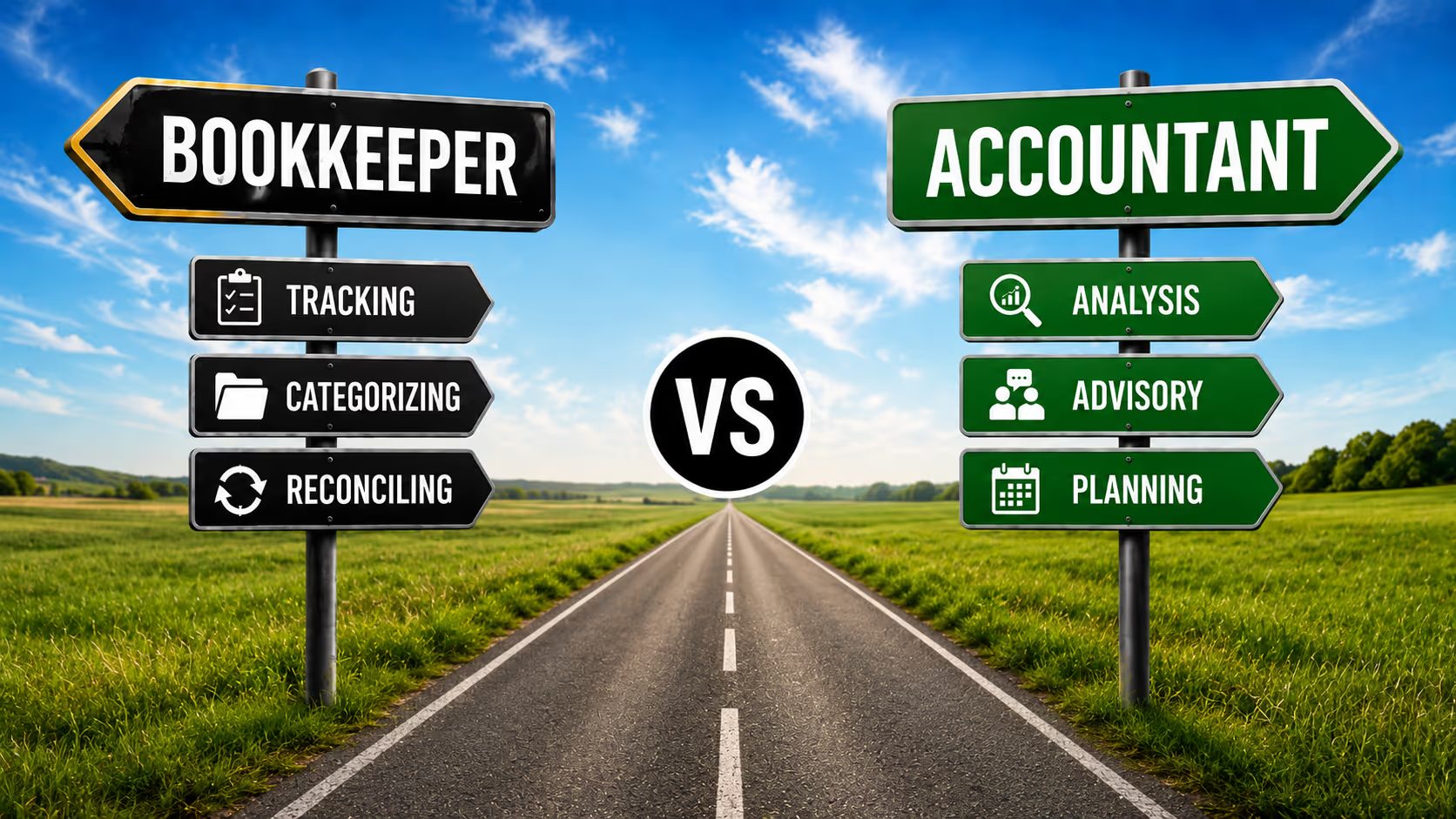
Most business owners conflate bookkeeping and accounting interchangeably. They assume the difference is seniority, price, or who prepares the tax return.
The bigger the business, the more that misunderstanding costs.
A business can have every transaction categorized and every account reconciled and still not have numbers that are right or useful. Your P&L may be too convoluted to tell you anything about your profit margins, what you can actually afford, or what you owe in taxes.
In other words:
Both matter. But they are not the same thing.
Bookkeeping is the foundation of your business.
A good bookkeeper makes sure daily business activity is captured correctly and consistently. That includes:
Bookkeeping is the first step towards reliable financial statements you can fall back on.
It feels simple enough to just "categorize" everything in QuickBooks Online, until you need to use the numbers.
A bookkeeper needs to understand where a transaction belongs, whether that is the Balance Sheet or the Profit & Loss, and enough about taxes to know when to flag something for a CPA.
For example, a loan payment is not an expense entirely. Part may be principal for the Balance Sheet, and part may be interest for the Profit & Loss. A business purchase is not always an immediate expense either. Often things like equipment, vehicles, and furniture need to be capitalized and depreciated.
Reconciling books means nothing was missed, but it does not mean nothing is wrong.
Accounting uses bookkeeping for financial planning and control.
The accountant’s role is strategic. The work goes beyond bookkeeping to assess big-picture finances and structure.
That can include:
Bookkeeping tells you the weather.
Accounting tells you what it means for you, what needs attention, and what you can safely do next.
The most common assumption I see is that reconciled books must be accurate books.
They are not always the same thing.
Reconciliations are important because that is how you know the activity in QuickBooks matches the activity in the bank or credit card account. However, reconciliations don’t prove that transactions were categorized correctly, or that the reports support the business return.
I have seen businesses where someone was reconciling accounts every month and assumed the work was done. But when we looked closer, legal expenses were sitting in liability accounts, loan balances were missing or negative, accounts receivable had negative balances, and expenses were being entered in a way that created false bills and false accounts payable.
The books had all the activity recorded. Yet they were useless.
One of our clients, a contractor business owner, had been relying on a bookkeeper who had not reconciled the books for years, unnoticed. Eventually, the accounts receivable and payable clerk began categorizing transactions and reconciling the accounts.
Because the accounts were now being reconciled, the owner and the AR/AP clerk assumed everything was good enough.
The owner focused on growing revenue and bringing in more work, while the financial problems kept compounding in the background.
When I reviewed the books, we found issues including:
The owner and team were forced to calculate profit numbers manually every week. They would estimate what was to be paid to the team based on their hours, what materials were needed, what was being billed to the client, and how much cash could safely be used before the next invoice is paid.
That is not a sustainable way to run a growing business.
Once the bookkeeping was cleaned up to finally get accounting in place for the business, the owner could finally rely on the financial statements. He could clearly see profitability, understand how much cash he needed to hold, and see how much cash is tax money.
We also split costs between direct and indirect, track labor and material costs by client, create job costing reports, and give the owner targets to manage.
Categorized transactions did not fix the process. Correct and meaningful numbers did.
Tax planning starts with your books.
If the bookkeeping is wrong, problems snowball into:
So often I see business owners complain about a tax planning problem when the real issue is a cash flow problem from lack of visibility into business profits and tax expense throughout the year.
When the return is done, it is often the first time the owner sees what they owe. And unfortunately, the IRS does not wait, and neither do payroll, rent, vendors, or loan payments.
A qualified bookkeeper can be a great fit when the business is straightforward and the owner mainly needs transactions categorized and accounts reconciled.
But businesses outgrow that. Here are the signs.
With increasing payroll, contractors, office costs, materials, and other overhead to cover, revenue alone does not tell you if a job or client is profitable. You need to understand what is left at the gross profit, operating, and net level before deciding what you can spend or pay yourself.
A business may have several services, client types, locations, teams, or projects. Without proper reporting, you could be pouring energy into the least profitable part of the business and have no way of knowing it.
A line of credit, SBA loan, equipment financing, or vehicle loan does more than add complexity to your Balance Sheet. Principal payments are not a tax deduction, but they still drain cash every month. Without accurate loan balances and visibility into what those payments are doing to your cash position, you are making decisions based on cash on hand that is not entirely yours to keep after taxes.
When your revenue is growing, your tax bill grows with it. Most owners find out how much at tax time, when there is nothing left to do about it. Quarterly estimates are a start, but they are based on last year's numbers. If this year is better, you are already behind.
When the stakes are higher, writing that check hurts more. And with the right books, tax visibility, and planning throughout the year, you can do something about it before it is too late.
As businesses grow, outside parties often request financial statements for financing, leasing a new location, bringing on a partner, or selling the company. A rushed cleanup is much more expensive than maintaining reliable records year round.
The title alone is not enough.
Anybody can wake up on a Tuesday morning and call themselves a bookkeeper or accountant. At the same time, not every CPA is experienced in QuickBooks Online.
Start with someone who actually knows the software your business uses. For QuickBooks Online, a Certified QuickBooks ProAdvisor is a good baseline because they understand the platform and the bookkeeping concepts behind it.
The right questions will tell you more than any resume will:
You are not ordering off a menu. You are hiring the financial foundation of your business.
A bookkeeper may be enough when your finances are simple, the business is simple, and you need accurate, up-to-date records.
An accountant who is a licensed CPA becomes a more valuable asset when you need someone to assess the bigger picture:
The accountant becomes even more valuable as both revenue and complexity grow. That may mean a growing team, uneven cash flow, multiple services, large tax bills, debt, locations, or major decisions that need to be made carefully.
Regardless of which one best fits your needs, the goal is the same. Simple, clean, and useful financials that you can rely on.
Clean bookkeeping gives you the foundation. Accounting gives you the insight and oversight from a CPA that helps connect the books, taxes, compliance, and decisions so you are not making expensive guesses as the business grows.
Trust that instinct. Books that look fine on the surface can still have issues underneath. We put together a list of things you can check yourself to give you a feel of where things actually stand.
Jose Cardenas, CPA, EA
Jose is a Certified Public Accountant in the state of Florida and an Enrolled Agent, and is the Founder of Westfront Tax & Accounting. He helps small businesses grow without expensive guesswork. His work is centered on helping owners upgrade to an audit-proof accounting process that helps them, not just the IRS. Since 2021, Jose has helped protect over $55M in client revenue through clean books, tax optimization, and financial systems built for growth.
.avif)
.avif)
.avif)